Dan Koe 的 AI 生意路线:给自己做品牌,替别人管内容
原文链接: https://x.com/thedankoe/status/2117664712532123680 来源: x.com 发现于: 小互 · AI 解读站 · 2026/11/9 说明: 本文由 AIHot汪 自动聚合(原文即中文,未翻译)。正文取自小互 AI 解读
全文 Markdown · 会员
作者:Dan Koe11-09 · 约 7 分钟⚑ 大佬观点 · 个人立场🎧 听播客版0:00 / --:--
视频/音频
0:00 / --:--
你给一位忙碌的创始人发私信,说自己会用 AI 写内容。他可能根本没空听。换一种开场:你先研究他的经历、读过他表现最好的作品,直接送上十条替他打磨好的稿子。对话就从介绍技能,变成了看作品。
这是 Dan Koe 在长文《2027 年最赚钱的 AI 生意》中介绍的获客办法。支撑这个办法的,是一套更完整的工作:弄清这个人值得讲什么,找到别人愿意看的表达,再把稿子做出来。
Dan Koe 是内容创作者,也是创作者工具 Eden 的创始人。他看好的方向,叫“一人创意团队”:借 AI 做研究和起草,由你统筹整套内容工作。客户已经能自己打开 AI,为什么还需要你?这正是全文要回答的问题。
这套服务怎样把材料变成内容 品牌资料你帮助谁 经历、信念、独特视角内容资料优秀旧作品 或影响自己的思想 再加上跨平台参考 ↓ 内容地图 方向 → 主题 → 点子 → 角度 AI 协助起草,人来核对与改稿 ↓ 给自己的品牌用持续发布,经营自己的受众。给潜在客户看用十条样稿展示能力,再争取合作。
依据 Dan Koe 的公开方法归纳两份输入与两个出口。正式客户的完整访谈,与争取第一单的样稿展示,是不同的工作场景。
一次被看见,和让人记住你,是两件事
好产品、好书、好本领,都需要有人知道,才有机会成为生意。Dan Koe 从这个常识出发:无论经营自己的事业,还是帮别人的公司增长,吸引注意力都是一项有商业价值的能力。钱花掉还能再赚,已经花出去的注意力却收不回来,这是他看重这项能力的理由。
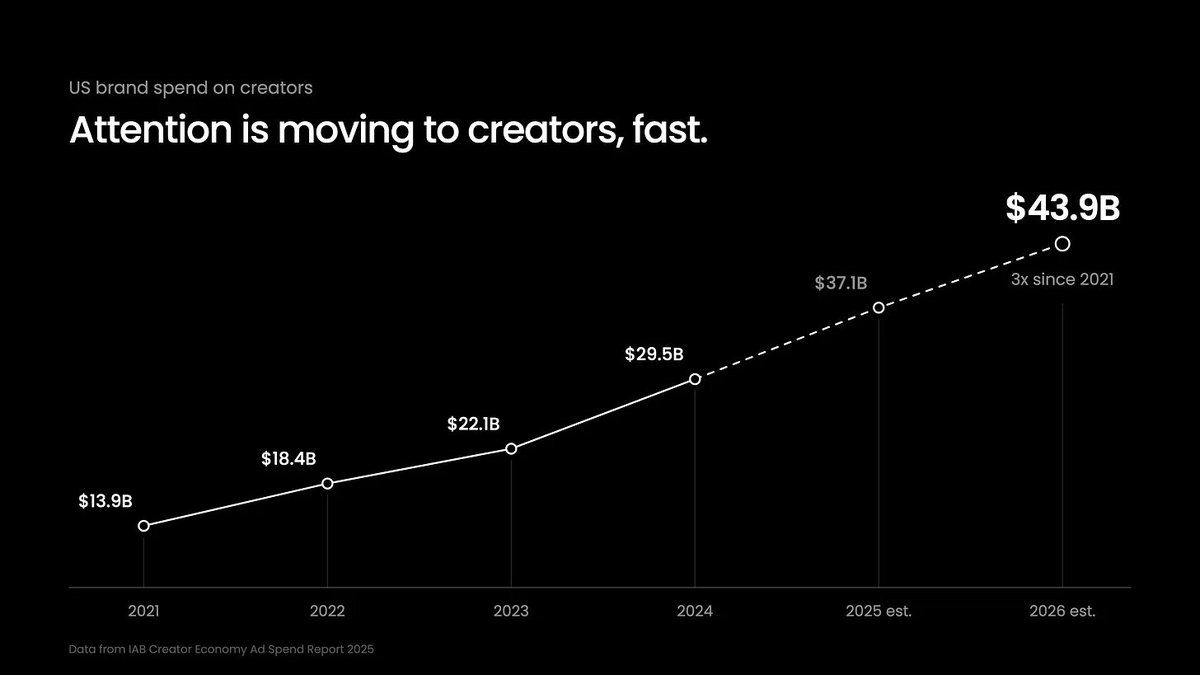
广告预算的变化给了他信心。IAB 的美国创作者广告支出数据,从 2021 年的 139 亿美元,增长到对 2026 年的 439 亿美元预测。公司越来越愿意花钱,通过具体的人触达受众,创始人亲自做内容也成了增长手段。

原文配图。横轴是年份,纵向数值单位为十亿美元;2025 年 371 亿、2026 年 439 亿美元是估计值,用虚线连接。这是美国广告支出,不是全球创作者收入。
但一条帖子有一百万阅读,其他帖子只有一千阅读,未必建立了能持续吸引人的品牌。这是 Dan Koe 举的假设例子:读者可能只喜欢那一条,并没有形成对你的认识。
内容让人停下来,品牌让人愿意再来看你。前者关乎眼前的选题和表达,后者关乎你长期谈什么、怎么看问题、有哪些别人没有的经历。他希望建立的是一组能互相呼应的内容,读者看完一篇,还想继续了解这个人。
一条内容爆了,人未必记住了你 其中一条:100 万阅读其余每条:约 1000
读者可能只为这一篇停留表现形状示意,不按比例 你的经历你的观点你的方法互相呼应,给人继续读的理由
阅读数字来自 Dan Koe 的假设例子;下方是“内容世界”的关系示意,不表示品牌建好后每条都能获得高阅读。
**文中另外两组市场数字怎么看?**高盛在 2023 年预测,全球创作者经济总规模可能从 2500 亿美元升到 2027 年的 4800 亿美元;WPP Media 在 2025 年中预测,创作者内容产生的当年广告收入约为 1849 亿美元。前者是全球市场规模,后者涉及内容和平台的广告收入,都不能当成创作者个人到手的钱,也不能与美国广告支出直接相加。高盛资料 · WPP Media 资料
会写稿,只接住了三种工作中的一种
AI 已经能生成帖子,客户为什么还会请人?Dan Koe 转述过合作内容团队的反馈:创始人要管理团队和业务,常常连想内容的精力都没有。他需要有人带着理解与判断,替他把这件事持续做下去。
一人创意团队要接住三种不同的工作:品牌定位先交代边界,内容策略据此选择题目,写作发布再把题目做成符合这个人的作品。给 AI 一个随机选题,会跳过前面的判断。
品牌定位
决定别人为什么要记住你。
服务谁、表达什么观点、怎样积累信任。不能为了追热点损耗可信度。 关心的是长期的认识与信任。 内容策略
决定下一篇值得做什么。
研究哪些主题有人看,标题、开头、形式为什么有效,再提出选题。 关心的是内容怎样吸引并留住人。 写作发布
把方向变成实际作品。
起草帖子、文章或视频脚本,按定位改稿,安排并完成发布。 AI 可以协助研究与初稿,人仍要看稿改稿。
读到最后一层的稿子,要接住前两层的决定:符合这个人的定位,也有适合读者的选题与呈现。
如果只研究爆款形式,可能做出好看的单篇,却没有稳定的个人面貌。如果只让 AI 连续出稿,连“这篇为什么值得写”都没人负责。Dan Koe 认为,很多 AI 内容生意停在了制作这一层。
这里有两条经营路径:给自己做,建立受众、邮件列表和数字产品;给别人做,为缺乏创作精力的创始人、公司或创作者提供服务。两条路都要求你统筹内容。经营自己的品牌,即使有 AI,也可能已经是一份全职工作;他还提醒,创作者要同时做软件,通常仍需团队。
他举到的 Eden 机构使用者,服务还包括邮件营销、数字产品发布,以及把受众引向购买的转化流程。这也说明,他讨论的服务范围可以延伸到内容发布之后的经营环节。
你成为自己或别人品牌的创意负责人。“you become the creative director of your own brand or someone else’s.”
Dan Koe 还转述了使用 Eden 的内容团队的另一项反馈:当时尚未裁员,但不扩编也能承接更多工作。这里体现的是团队承接能力的变化,与下面个人少花多少工时,是两个层面的观察。
文中一位内容团队使用者描述,自己的工作已变成审查和改写草稿,每天耗时从 12 小时变成 4 小时。这是 Dan Koe 转述的个人口述,能帮助理解工作怎样变化,不能据此推算所有人的效率。
**“一人团队”能收多少?**Dan Koe 设想,能力成熟的人服务 1—3 个客户,每月做到 1 万—7.5 万美元并非不可想象。他比较的是雇用完整团队的成本:对原本就有较大营销预算的企业,这种收费仍可能只是团队成本的一部分。这是他的商业判断,没有公开成交样本、成本或成功率,不能当作新手报价表。他同时强调需要练习,别把它当快速致富机会。
先采访这个人,再让 AI 替他起草
真正的第一步,发生在写稿之前:和客户聊一次,录音、转写,把他是谁整理成以后能反复参考的资料。做自己的品牌,也可以回答同一组问题,让 AI 辅助访谈和归档。
Dan Koe 把这份材料叫个人的“思想签名”。可以把它理解成观点底稿:记录这个人帮助谁,经历过什么,哪些事有自己的看法。没有这层上下文,换个名字也成立的稿子就很容易出现。
写稿前,先做一页人物访谈原文九类问题的中文整理 你想帮助谁想到一个真实的人。他糟糕的一天是什么样?向朋友抱怨时,用的原话是什么?试过哪些没用的办法? 你走过什么路哪些经历与读者相似?转折发生在哪,哪怕变化很小?做成过什么、试过什么、失败过什么,又想通了什么?自己或帮助过的人,有哪些结果能拿出来看? 谁影响了你哪些具体的人、书、文章或视频改变了你的想法?哪些观点反复想起,为什么?即使后来不再赞同,也可以记录。 你能一直聊什么先列所有兴趣,再选最在意的两三个。你用什么独特角度理解它们?别人常找你问什么?哪些事你一遍遍向人解释? 你相信什么一句话说出想帮助人做到的事。你相信什么,而同行多数人并不认同?行业里哪些常见建议,你认为错了? 你反对什么想帮读者摆脱哪种生活、习惯或误解?针对的是观念和做法,不是攻击某个人。 为什么现在谈世界发生了什么变化,而你想帮助的人可能还没意识到? 你想带人去哪跟着你走五年,读者希望怎样生活、怎样介绍自己?你在这段路上扮演什么角色? 你有哪些自己的说法理想读者每天相信并遵循哪些规则?列出 5—12 条。给自己的想法、方法或问题起过什么名字?每个名字分别是什么意思?
目的在于留下可反复调用的个人材料,无须一次访谈就得到完美的品牌宣言。
这一页也不用塞进一条帖子。Dan Koe 建议在接下来 6—12 个月的内容里,逐渐让人看见这些经历、信念与视角。品牌是这样被认识的,靠一段自我介绍很难完成。
一次访谈,留下什么 录下对话保留真实说法读者怎样抱怨,你怎样讲自己的经历。 转成文字可以反复查阅的访谈记录以后想题、核对表达时,能回到这份材料。 整理成文品牌资料受众、经历、信念、自己的概念与说法。 写稿时用给 AI 背景,也给人核对的依据检查观点是否符合这个人,故事是否有出处。
做自己的品牌,也可以把问题交给 AI,让它访谈自己并整理文档。资料要保存在以后能找到、能继续引用的地方。
当 AI 再来帮忙想选题、写初稿时,你就有了可以检查的依据:这件事真是他经历过的吗?这个观点符合他一贯的看法吗?这句表达听起来像他吗?资料的作用,是让写作有东西可依靠。
读者向前走的时候,你扮演什么角色?
访谈里有一组问题特别影响后面的表达:跟着你走五年,读者的一天会是什么样?他们希望怎样介绍自己?以及,你在他们的故事里是谁?前两个问题交代要去哪里,最后一个问题交代你怎样参与这段路。
向导帮助读者理解路径,带着他们向前走。 过程记录者自己也在路上,把正在尝试、遇到的问题和变化记录下来。 带地图回来的人走出过类似的处境,回头帮助仍在其中的人。 读者今天的生活困扰、失败的尝试、向朋友说的原话。→他们希望走向的生活五年后的日常,想成为怎样的人。
三种角色是 Dan Koe 给的例子,用来想清自己与读者的关系;五年描述是愿景,不是服务效果承诺。
这些问题也让“世界观”有了具体内容:你认为什么值得追求,哪些常见做法让人走弯路,想帮助人摆脱什么。同一个选题,由向导给出路径,或由记录者展开自己的尝试,写出来就会不同。这是把个人背景带进内容的一种方式。
有旧作品,就从里面找;还没发过,就找影响你的人
访谈记下的是这个人怎样认识自己,旧作品则提供了已经说出口、也得到读者反馈的材料。Dan Koe 建议,从客户活跃的每个平台选出 10—20 条表现最好的内容。
请 AI 从中整理三件事:反复出现的核心观点,表达里有个性的地方,以及可能把读者聚在一起的世界观。再由你亲自跨平台看一遍优秀作品,找可以再次使用的规律,判断 AI 的归纳是否成立,存成一份内容资料。

原文的 Eden 界面截图,展示 Dan Koe 的历史作品排行。它说明可以从过往作品入手找材料;热门标签和互动数字本身,并不能证明内容生意的收益。
这一步也解释了为什么他没有主张全自动代笔。在他看来,AI 已能处理公司口吻,个人品牌的独特表达仍很难被完全复刻。访谈和旧稿要组成的是知识库,帮助人更容易找到材料、起草和修改。最终仍需保留这个人的特点。
如果你还没有发布内容,就列出 5—10 位对自己影响最大的人。可以是创作者,也可以是写书的人。用同一套研究任务分析他们的公开作品;没有社交账号的,就让 AI 从全网和书籍中整理重要思想,再追问:为什么这些想法影响了我?它们与我的经历在哪里相遇?资料同样要存成文档。
Dan Koe 对独特性的理解,是他人的思想在你身上产生新的组合。收集参考之后,还要经过自己的理解;当新观点更有解释力时,也要愿意更新原来的看法。这个过程与照搬别人的结论有明显距离。
别人的思想,怎样变成你的理解 Dan Koe 列举的思想来源NavalLeo GuraMihaly CSteven KotlerKen Wilber+自己的经历做过什么 失败过什么 想通了什么 在自己的处境里,重新理解这些想法 ↓ 自己的观点与表达吸收思想之后,还要说清自己怎样理解、为什么认同。
这是 Dan Koe 对思想独特性的解释。名单是他的例子,读者要找的是实际影响过自己的人。
去自己不发内容的平台,找新的参考
Dan Koe 特别建议,研究自己没有发布内容的平台。一直盯着同一个平台,容易反复遇见相似的表达;在别处看见的选题与结构,可能给自己的内容带来新的入口。
Dan Koe 用艺术家收集参考来解释这件事。研究热门内容,可以观察一个题目怎样切入,标题怎样提出问题,视频怎样留住观众。借鉴的是形式和规律,自己的观点、经历与判断仍要放进去。
跨平台时,把什么带回来? 视频内容研究标题、缩略图、开头与留住观众的方式。 帖子与文章研究有效的选题、形式和表达结构。 提取规律与参考 ↓ 回到自己的发布平台带着自己的品牌资料和内容资料,重新组织表达。
调研看的是可借鉴的规律;别人的观点、案例和个人经历,需要与自己的材料分清。
原文的工具路径,是把 Eden 连接到 Claude 或 ChatGPT,再由 AI 读取内容资料;其中 MCP 是 AI 连接外部工具的接口。Dan Koe 还推荐用 Eden 做跨平台研究。这些是他的产品介绍,本次没有实测连接与调研功能。
把“我想说什么”和“别人愿意看什么”放在一起
到这里,两份底稿与调研结果都已经就位。第一份记“人”:访谈整理出的经历、信念与想帮助的读者。第二份记“内容”:优秀旧作及其特点,或影响自己的思想参考。现在把这两份资料与前面的跨平台调研结果放在一起,整理成内容地图。
两份底稿,长成一张内容地图 人物与品牌资料 + 内容资料
3—4 个长期方向例如:内容创作。 每个方向 5—7 个主题其中一个主题:选题方法。 每个主题 5—10 个点子其中一个点子:从读者留言找选题。 每个点子 4—5 个角度一个角度:拿一条假设留言,演示怎样变成下周选题。
以一个虚拟的内容创作账号示意,只展开一条分支,并非原文案例。数量是 Dan Koe 的建议范围,不必填满;研究时参考过去 6—12 个月的内容表现。
下面把长文公开的两段任务整理在一起:先得到内容资料,再用两份资料生成内容地图。
两段公开任务的中文整理 · 可以带着自己的材料照做 先研究已有内容,再生成内容地图
**任务一:整理优秀内容。**给出本人或参考人物的账号。研究他们在每个平台表现最好的 10—20 条内容,整理核心观点、有个人特点的表达,以及可能让读者产生认同的信念与世界观;从作品中推测的部分要标明。归纳可能促进账号增长的因素和可以再次使用的内容规律,汇总成一份文档。
**任务二:生成内容地图。**同时提供品牌资料与内容资料,先提取自己的长期方向和独特视角,再跨平台研究相关主题在过去 6—12 个月有效的内容。规划 3—4 个长期方向,每个方向 5—7 个主题,每个主题 5—10 个点子,每个点子 4—5 个表达角度,整理成易读的文档。
后续让 AI 起草时,继续带上这些背景,并参照有效作品检查每篇的结构。两项任务依据长文内公开的提示词改写;外链综合提示词未读取。
地图给的是可以继续打磨的内容储备。Dan Koe 估计,它能提供大约半年的选题思路。实际写哪一篇、用什么结构,仍要回到资料与内容表现上判断;分支数量多,并不等于已经有同样多的好作品。
这套流程最有用的地方,是让“别人爱看”和“只有你能讲”在写稿前相遇。先完成这些准备,再请 AI 起草,你面对的就不再是一张白纸。
第一单,从一份已经做出来的作品开始
开头那十条稿子的做法,来自 Dan Koe 讲述的朋友 JK Molina 的私信。大意是:知道 Dan 不想找人代笔,但还是先替他写了十条,请他试着发布;喜欢的话可以继续合作,或者留一份评价。
这里要区分两种场景:争取合作时,用对方已有的公开表达先做展示稿;正式合作后,再用访谈补齐背景。前面的录音访谈,是 Dan Koe 描述的客户入驻流程。
这个办法把客户需要想象的部分提前做了出来。他不用先相信你的自我介绍,就能看到你是否理解他、能不能交出东西。Dan Koe 称它为“Permissionless Apprentice”:先替理想客户做一份作品,再设法让对方看到。
他给出的行动建议,是运用前面的资料研究流程,起草十条内容,亲自打磨,再每天联系十位潜在客户。对忙碌的创作者、创始人,以及内容增长遇到困难的人,都可以寻找这样的展示机会。
他设想这类服务首单可以按每月 2500—5000 美元谈,并认为坚持一个月有机会找到客户。这些是他的经验判断,没有公布联系次数对应的成交率。文章并未提供按这套步骤执行就能签约的证据。
第一单,先让客户看见交付 研究读他的经历和优秀旧作,理解这个人的特点。 制作先替他做十条内容,用 AI 协助起草,由你打磨。 展示把作品送到对方面前,私信或公开展示都可以。 再谈合作对方先用作品判断价值;是否愿意合作,仍要得到回应。
Dan Koe 的先做作品再争取合作方法。这里画的是行动路径,不表示每天联系十人就一定能成交。
私信不奏效,也可以公开展示。Dan Koe 举了一条视频帖:一位创作者直接以 Grant Cardone 需要新的创意负责人为切入点,展示自己的申请。他在文中转述 Grant 的回应,借此说明作品有可能引来对话。

原文附的是 august_carlsson 的 Reel 静态截图,画面提出为 Grant Cardone 担任创意负责人的申请。本次拿到的是图片,没有视频文件;回应来自 Dan Koe 的讲述,也没有核实后续签约。
回到客户为什么付钱:你需要交付的,不只是一批能生成的文字。你要理解这个人,把他的素材与读者的兴趣连起来,选出值得做的题目,再把初稿改到可以用。AI 参与了制作,客户仍需要有人承担这些责任。
这一点,也把整套方法的门槛讲清了:愿意研究人、研究内容、不断改稿,才有“一人创意团队”的工作。十条作品,只是让别人看见这份能力的开始。
按什么顺序,把整套方法做一遍?
下面把前面的公开方法排成一份执行提纲。阶段名称和“核对产物”是本文的编辑归纳,方便照着检查;找客户的最后一段,适用于给别人提供内容服务的人。
先定服务方向
- 决定给自己的品牌做,还是替别人做。
- 描述一个真实的服务对象,想清想帮助他做到什么,以及自己与他的关系。 **核对产物:**能说清服务谁、带他去哪里、自己扮演什么角色。
留下两份资料
- 自己的品牌或正式客户,用九类问题访谈并留存记录;争取首单时,先据对方公开内容整理背景。
- 每平台研究 10—20 条优秀旧作;新手整理实际影响自己的 5—10 人。
- 把观点、个人表达和世界观整理成内容资料。 **核对产物:**两份文档可查阅,后续写稿能继续引用。
调研与规划
- 跨平台收集参考,提炼选题和结构的规律。
- 结合两份资料,按方向、主题、点子与角度整理内容地图。
- 研究过去 6—12 个月有效的作品。 **核对产物:**地图里的点子既有个人视角,也能说明参考了哪些有效内容。
起草与改稿
- 让 AI 带着已有背景起草。
- 由人审查、改写,保留自己的观点和表达特点。
- 参照有效作品检查结构;给自己的品牌用,可以安排发布,给潜在客户用,则进入样稿展示与合作沟通。 **核对产物:**交出去的是经过自己判断和修改的作品。
用作品争取第一单
- 面向忙碌的创始人、创作者或内容增长遇到困难的人。
- 先做十条并打磨,带着作品争取对话;私信无效时,可以公开展示。
- 每天联系十位、坚持一个月,是 Dan Koe 提出的尝试,不是签约保证。 **核对产物:**已经有能让目标客户直接评价的具体作品;成交要以实际回应为准。
先把背景资料搭好,再反复使用、研究和改稿。半年储备与长期品牌都需要后续工作,不能用内容地图的分支数量代替实际作品。
来源The most lucrative AI business to start in 2027Dan Koe·查看主材料延伸X Article 长文地址·FTS 三页图总结(图解组织参考) Dan Koe · 内容创作者、Eden 创始人
一套 AI 内容方法,两条生意路线
AI 协助研究与起草,由人负责定位、选题和改稿;既经营自己的品牌,也能为别人提供内容服务。 长文逻辑拆解 · 核心机制模型 · 约 4 分钟阅读
你给一位忙碌的创始人发私信,说自己会用 AI 写内容。他可能根本没空听。换一种开场:你先研究他的经历、读过他表现最好的作品,直接送上十条替他打磨好的稿子。对话就从介绍技能,变成了看作品。
Dan Koe 从这个常识出发:无论经营自己的事业,还是帮别人的公司增长,吸引注意力都是一项有商业价值的能力。钱花掉还能再赚,已经花出去的注意力却收不回来,这是他看重这项能力的理由。
139亿 → 439亿 美国创作者广告支出(美元):2021实际→2026预测
100万 / 1000 Dan Koe 的假设阅读量例子,非普遍统计
2500—5000 美元/月:作者设想的首单服务报价
**内容让人停下来,品牌让人愿意再来看你。**前者关乎眼前的选题和表达,后者关乎你长期谈什么、怎么看问题、有哪些别人没有的经历。但一条帖子有一百万阅读,其他帖子只有一千阅读,未必建立了能持续吸引人的品牌。这是 Dan Koe 举的假设例子:读者可能只喜欢那一条,并没有形成对你的认识。
AI 已经能生成帖子,客户为什么还会请人?Dan Koe 转述过合作内容团队的反馈:创始人要管理团队和业务,常常连想内容的精力都没有。他需要有人带着理解与判断,替他把这件事持续做下去。
核心机制 · 内容工程的三层模型 三种工作都需要人的判断,AI 协助整理、研究和起草
第 1 层 · 品牌定位 **交代边界与世界观:**明确这个人帮助谁、经历过什么、在读者的故事里扮演向导还是记录者。缺少这层底稿,换个名字也成立的平庸稿子就会大量出现。 人定方向 · AI 辅助整理
第 2 层 · 内容策略 **决定选题与表达方向:**研究过去6—12个月有效的内容,结合自己的材料形成内容地图。Dan Koe 估计可得到约半年的选题思路,仍需判断和打磨。 人统筹 · AI 协助研究
第 3 层 · 写作发布 **起草、改写与跨平台制作:**根据定位要求完成初稿生成、口吻润色与分发排版。很多 AI 内容生意仅仅停在了制作这一层。 AI 协助起草 · 人审改
一人创意团队要接住三种不同的工作:品牌定位先交代边界,内容策略据此选择题目,写作发布再把题目做成符合这个人的作品。如果只研究爆款形式,可能做出好看的单篇,却没有稳定的个人面貌。如果只让 AI 连续出稿,连“这篇为什么值得写”都没人负责。Dan Koe 认为,很多 AI 内容生意停在了制作这一层。
先留下可反复引用的个人资料:做自己的品牌,可以自我访谈;正式客户合作后,用录音访谈、转写补齐经历与观点;争取首单时,先研究对方已有的公开内容做样稿。资料记录帮助谁、经历过什么、相信什么,成为以后想题和改稿的依据。
内容地图的生成逻辑:两份底稿与跨平台调研的交汇
轨道 A · 思想签名(关于“人”) **读者未来愿景:**跟着你走五年,读者的一天会是什么样?他们希望怎样介绍自己? **角色与世界观:**你在他们的故事里是谁?什么值得追求,哪些做法让人走弯路?
轨道 B · 内容资料(关于“共鸣”) **已有旧作:**在每个活跃平台各选10—20条优秀内容,提炼核心观点、个人表达,以及可能凝聚读者的世界观。 **尚未发布:**研究真正影响自己的5—10人;没有账号时,从全网和书籍整理思想。无论哪条分支,都再到自己不发内容的平台收集参考。
汇流产物 · 内容地图(选题思路) 品牌资料记“人”,内容资料记旧作特点或思想参考,再结合跨平台调研。地图展开为3—4个长期方向→每个5—7个主题→每个5—10个点子→每个4—5个角度。起草时继续带着背景,参照有效作品检查结构;这些分支是待打磨的思路,不是已经完成的作品。
同一套方法,两个经营出口给自己的品牌用持续发布,经营受众、邮件列表和数字产品。替别人统筹内容为缺乏创作精力的人研究、选题、改稿和交付。下面的十条样稿,是争取这类客户的一种起步办法。
开头那十条稿子的做法,来自 Dan Koe 讲述的朋友 JK Molina 的私信。大意是:知道 Dan 不想找人代笔,但还是先替他写了十条,请他试着发布;喜欢的话可以继续合作,或者留一份评价。
技能自荐 私信介绍“我会用 AI 写内容”。客户要从自我介绍里想象合作效果,忙碌时可能没空判断。
先做作品,再争取合作 研究对方已有的公开内容,先做十条并打磨,再用作品争取对话。私信不奏效,也可以公开展示。对方能直接看你是否理解他、能交出什么。
**商业边界与条件提示:**Dan Koe 设想这类服务首单可以按每月 2500—5000 美元谈,并认为坚持一个月有机会找到客户。这些是他的经验判断,没有公布联系次数对应的成交率。文章并未提供按这套步骤执行就能签约的证据。回到客户为什么付钱:你需要交付的,不只是一批能生成的文字。你要理解这个人,把他的素材与读者的兴趣连起来,选出值得做的题目,再把初稿改到可以用。AI 参与了制作,客户仍需要有人承担这些责任。
原文版权归原作者,这里只供对照阅读。 看原网页 ↗
The most lucrative AI business to start in 2027

The most lucrative skill has always been capturing attention.
It’s obvious why.
If your goal is making more money, it doesn’t matter how good a software you build. It doesn’t matter if it took you 3 years and endless scrapped drafts to write a book. It doesn’t matter if you work hard and improve yourself to increase your career opportunities.
If nobody knows who you are or what you offer, how in the world are they going to pay you?
Meaning, whatever your work is or whatever business you build, capturing attention and acquiring customers will be the primary thing that determines your success.
This applies to both your own business and others’ businesses.
And other people will pay top dollar for you to do it for them.
As job security goes down, people are met with 3 options:
- Complain about how life is unfair and do nothing
- Upskill and reeducate to find a better job opportunity
- Start building the business you’ve always wanted to build
An absurd amount of people will choose option 3.
As you could guess, and as everyone is screaming about on social media, the way they will build that business is by starting a personal brand.
Why?
Because attention is a finite resource, and it’s only becoming more scarce. People can make more money, but they will never get back the attention they spent.
In this letter, I will show you how to master attention capture on social media. That way, at least for the next few years, you won’t have an issue making money.
With what you learn, you can start your own business using social media to fuel it, or become a “one person creative team” for other companies that will pay top dollar for your skill set.
Promo - Workshops for the Second Renaissance:
I’m teaming up with Hussain Ibarra (grew from 2,600 to 20,100 Substack subs) to teach newsletter and article writing that people actually want to read.
If you’ve considered building a Substack, or want to write better X articles, sign up here, it’s $49 but will teach you the skills to make far more than that.
I – You will either become a creator, pay a creator, or get paid to work for a creator.
The data is almost too hard to ignore.
Goldman Sachs predicts the creator economy will nearly double, from $250 billion in 2023 to $480 billion by 2027.
In 2025, creators earned about $185 billion in ad revenue, which is the first year they passed traditional media.
US brands spent $13.9 billion on creators in 2021, and the IAB expects that to reach $43.9 billion in 2026, which is about 3x in 5 years.
Absurd.
And as someone who both is a creator, has worked for creators, and pays creators, the prices people charge are crazy. There is an absurd amount of VC money being thrown around, paying thousands of dollars for a single reel or 60-second YouTube time slot (that don’t even bring results 90% of the time).
The point is that social media is where the attention is. Not the radio, TV, or news anymore. When you want to start any kind of business - from lifestyle business talking about your interests to the next unicorn startup, posting content is almost a given at this point for how you attract an audience that pays you.
When companies want to expand, they put millions of dollars into affiliate and partnership campaigns. I keep getting ads from Hormozi saying they pay over a million a month to creators to promote Skool. And that’s aside the fact the Hormozi is a creator, which massively helps grow Skool.
“Founder-led marketing” is now a buzzword in the startup space, which essentially means that the latest and greatest way to grow your startup is... you guessed it, starting a personal brand and posting content (and most of them are horrible at it by the way, and you should probably start using Eden to research, differentiate yourself, and post).
What does this mean for you?
It doesn’t matter if you plan to work for yourself, have a business already, or want to work for another business - the most lucrative skill to learn is capturing attention. When you translate that to the digital landscape, the most lucrative skill is creating content - good content, not infinite slop.
Unfortunately, you can master capturing attention, but that doesn’t mean you’ve actually captured it.
Getting a million views on one tweet or reel is useless if the rest of your posts get a thousand views a pop. That signals that your content is decent, but your brand is non-existent. We need both.
You can try to go viral all the time, which is what most people do (and why most people fail abysmally), or you can build a world of content that people can’t help but explore.
I’ll teach you how to do that.
II – The One-Person Creative Team
There is a massive shift happening in the content space right now.
I’m the founder of Eden, a tool where creators and digital businesses research viral ideas, plan and schedule their content, sell digital products, and run their email list.
That’s not meant to be a pitch. It’s to point out that we have data about this that almost nobody else has. We know what topics, hooks, and content styles work across billions of posts.
Aside that, freelancers and agencies use it to run their clients’ personal brand, from content to email marketing to digital product launches and building funnels.
We talk with these content agencies and media teams, and they are all saying the same things (paraphrasing):
“We’re not firing people yet, but we can take on so much more work without expanding the team because everyone’s output has gone up.”
“The reason creators and founders hire us is because they don’t even have time to think about content. They have a team to manage and a business to run, which requires focus. AI can write content for them, but they still know they need a strategist or creative director who leverages AI better than they would. It still requires creativity and thought.”
“AI still can’t write the best posts, and I don’t think it ever will, but it can research what’s performing, understand the strategy, and draft posts that are almost there. My entire job nowadays is reviewing and rewriting drafts. It takes me 4 hours a day instead of 12 now.”
The most lucrative AI business to start (as one person), in my eyes, is two-fold.
One - you can become your own creative team. Start a personal brand. Build an audience. Create digital products. Build an email list. All that stuff. And that is your sole focus. Trust me when I say it is a full-time job, even with AI. If you are a creator, you probably aren’t going to build software without a team.
Two - you can become someone else’s creative team. Help companies, founders, and even creators who don’t have the creative bandwidth to put out irreplaceable content. Most founders still create “announcement” style content and have no idea what it takes to build influence online.
In other words, you become the creative director of your own brand or someone else’s.
If you can pull this off, I don’t see why you wouldn’t be able to demand a price that is a fraction of what a full team costs. $10-$75k a month for 1-3 clients isn’t that far out of reach (if you’re good at this and practice - don’t let your mind convince you this is your next opportunity to get rich quick). And business owners who pour millions into marketing won’t bat an eye at that price.
What does this one person creative team look like?
What skills do you need to learn?
Job 1) Brand Strategist
A brand strategist is in charge of positioning and perception.
They are going to be the first to say that you shouldn’t just follow trends and try to go viral with every post. Growth and engagement are important, but not at the expense of trust and authority.
I’m going to show you how to do all of this below, by the way.
2) Content Strategist
Not the same as a brand strategist.
The content strategist is someone who scouts what content is performing in various topics and niches and proposes what the creator’s next posts should be. They deeply study post formats, YouTube thumbnail and title structures, retention, and virality.
They are good at growing accounts, but without accounting for brand strategy, if the creator were to stop posting, nobody would ask where they went.
3) Content Writer / Social Media Manager
The person who drafts the tweets, YouTube or Reels scripts, X articles, and Substack newsletters, plans them, and posts them.
They take the content strategists ideas and brand strategists direction and make sure the content aligns with that.
You can probably tell why most people are failing to build anything lasting with AI. They still treat it as a get rich quick scheme. They think that if they just have Claude pump out scripts without direction or data they’re going to magically build a connection with their audience.
Almost nobody accounts for brand strategy.
Some people account for content strategy.
Most people just turn random ideas into posts and pray that they’ll do well.
This is your competition, and it’s not hard to stand out.
III – If You Were My Client, Here’s Exactly How I’d Build an Irreplaceable Personal Brand
Let’s have some fun with this.
I’m going to act like I’m onboarding you as a client.
That way, if you want to become a creator, you can implement the process yourself. And if you want to start a content business for others (ghostwriting tweets, writing Substack articles for brands, etc), this is how you would bring them on as a client (I’ll give you one of the best strategies for landing your first client later).
Step 1) Onboarding Call To Create Their Intellectual Signature
To make their brand and content unique, you need quite a bit of context from them.
After you land them as a client, schedule a call with them so you can interview them for everything you need. Record the call so you’re able to store the transcript somewhere and reference it with AI.
If you’re doing this for your own brand, I already have a quiz / prompt you can use. It also comes with a 30 day creator sprint course. It builds your strategy for you based off of what’s going viral right now mixed with what makes you unique. Try it here.
This is what you would ask your client, or you can ask yourself. You could also paste this into Claude and have it pull the info out of you and save it as a brand document you can reference with AI at any point.
All of these questions shape your brand.
They can spin off into content topics, and are something you post about over 6-12 months. People see this and ask “How do I get this all across in one post?”
You don’t. This is a long term game, and is why most people fail miserably. Because they want quick attention and authority. Good luck with that.
Since this is long, I put all of this and more into a comprehensive prompt for you, save it or duplicate it to your workspace.
- Who you help Who do you most want to help? Describe one real person. What does a bad day look like for them right now? What do they say when they complain to a friend? Use their exact words. What have they already tried that didn’t work?
- Your story What have you lived through that your audience is living through now? What was the moment things changed for you (no matter how small)? What have you built, tried, failed at, or figured out? List them from biggest to smallest, they are all worthy. What results can you point to, for you or for people you’ve helped?
- Who shaped your mind Whose books, posts, or videos do you never skip? Name real people and titles. Which idea from them do you keep coming back to, and why? Who changed how you think, even if you disagree with them now?
- Content pillars and unique perspective What could you talk about for hours? List everything, even things that seem unrelated. Of those, which 2 or 3 matter most to you? How do you come at each one differently from others? (For example “through psychology” or “as a former nurse”) What do people ask you for advice on most? What do you keep explaining to people over and over?
- Mission and beliefs In one sentence, what do you want to help people do? What do you believe that most people in your space don’t? What common advice in your field do you think is wrong?
- What you’re against What way of living is hurting the people you want to help? What life do you want to help them escape? Answer in your own words. What myth or habit would you get rid of if you could? (A habit or idea, not a person or company.)
- Why it matters right now What just changed in the world that most people haven’t noticed yet?
- Where you’re taking them What does their day-to-day life look like five years after following you? What would they proudly call themselves in their own bio? Who are you in their story? (Their guide, someone documenting the journey, or someone who got out and came back with a map.)
- Rules and words What does your ideal reader believe and do every day? List 5 to 12 rules. Do you have names for your own ideas, methods, or problems? Write each name with what it means.
Keep all of this information somewhere safe, like a brand board in Eden so you can reference it whenever you are ideating post ideas.
Step 2) Scrape Their Best Content If They Are Posting
I think we can all agree AI can’t replicate someone’s voice.
Even if it gets close, there’s always going to be one little thing that feels off about it.
That’s not our goal with this. AI can handle company voices just fine, but a personal brand is personal for a reason. It needs that hit of uniqueness.
The reason we interview them and pull in their best content isn’t to automate the entire process. Instead, you’re building a knowledge base of everything that is unique or noteworthy about that person. When you use AI to brainstorm, draft, or ideate, it becomes so much easier than starting from scratch.
To pull in their best content on all platforms, connect Eden to Claude or ChatGPT with the MCP so it can pull in their posts or others posts that are going viral, give it their social handles, and use a prompt like this:
Pull the best content from [@handles]. 10-20 posts from each platform they are on. Then, I want you to note down the core ideas that make them unique, the aspects of their voice that have personality, and a guess at what their worldview or philosophy is that could rally other people behind it. In essence, note down everything that led to their growth, and compile it into a document.
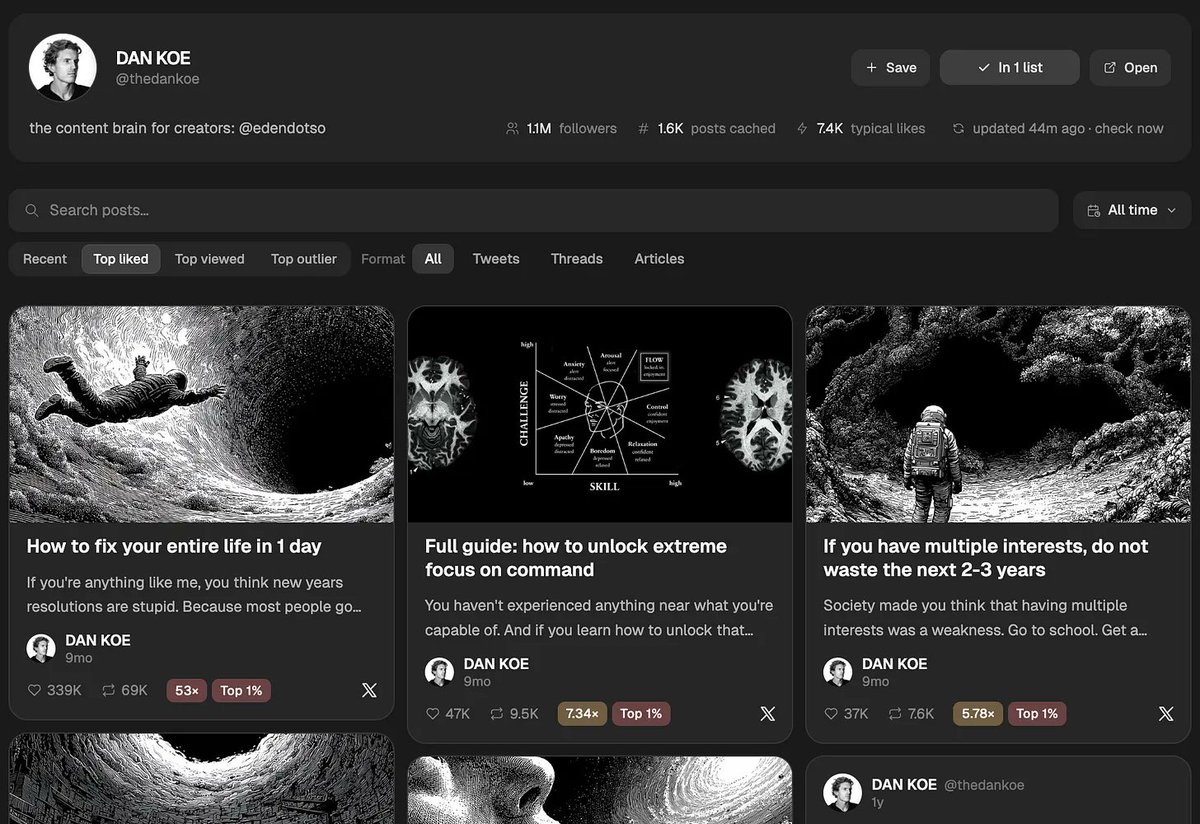
It’s also worth just looking at their top posts on all platforms so you can spot patterns that are replicable.
Step 2.5) If You Haven’t Started Posting Content Yet
As a beginner, this is arguably the best thing you can do.
You must understand that your mind has been shaped by those who have impacted you the most. Your best ideas - the ones that will lead to your growth - are how you interpret the ideas you’ve adopted from others.
Similar to “steal like an artist,” except it’s just how the mind works.
It’s a core sign of intelligence to swap the beliefs and ideas running your mind when you are exposed to a new one. It is a sign of stupidity to never let go of beliefs or ideas that do not lead to advantageous outcomes.
My mind is largely composed of ideas that have been mashed together from Naval, Leo Gura, Mihaly C, Steven Kotler, Ken Wilber, and more. The interaction of those ideas in my head, plus my own life experience, is what makes my ideas mine.
So, if you aren’t posting content, create a list of 5-10 people who have impacted you the most.
If they are creators, even better. Put them in a list so you can see all of their content or chat with it.
Then use the same prompt mentioned above, but for their social handles. If they don’t have social media, ask AI to pull their best ideas from across the web and their books. Save it as a document somewhere safe.
Step 3) Create A Research-Backed Content Map
So far we have:
- Gotten enough brand context to create something unique
- Documented the best ideas that we can reuse, reposition, and replicate
Now, we need to put on our marketing hat.
And it’s not even a marketing hat. It’s an artists hat.
Most “creatives” hate the thought of researching viral posts, or top performing YouTube titles, or basing your content off of what is more likely to perform... but you’re just looking at it from an angle that hides what you’re actually doing.
You’re collecting references.
That’s what artists do. They have inspiration boards and references that help shape their work. They don’t copy it 1-1, but they pull patterns and principles so that their own work is likely to perform better.
Because let’s face it, you want your work to be a success. You just think looking at data feels icky and somehow isn’t a part of the creative process. Snap out of it.
Here’s what you do.
(Disclaimer: I’m mentioning Eden a lot in this letter, because frankly there isn’t anything else that can do the job. Social scrapers can’t see what’s performing across more than one account, and apps like GrokBot are incredible, but only work on X, and you’re better off researching platforms that you’re not posting on to get unique ideas).
It’s as simple as using this prompt, and plugging the 2 documents you’ve made so far into it:
I want you to create a research backed content map: 3-4 unique and broad content pillars that branch into 5-7 topics that are both based on ideas that are working, through my own unique lens based on [@ brand document] and [@ content document]. Branching off each topic should be 5-10 ideas that are likely to perform well, with 4-5 angles branching off of each of those ideas. Look over my brand and content docs, pull potential pillars and my lens out of it, then use Eden to research what’s performing across platforms in those topics. We want a unique content map, but we want to merge it with patterns that have been proven to perform over the past 6-12 months. Put the output in an easy to read document.
Now you have about 6 months of content ideas that you can work with. You can ask Eve or AI to draft them using the previous context we made, and validate the structure of the post based on what’s performing as well.
I think it’s hard to deny that you wouldn’t see results with this process, and that it puts you miles upon miles ahead of those who are not doing this.
As mentioned, here’s a doc/prompt you can duplicate with the entire process in it. It may take a bit to get through, but it is comprehensive.
IV – How to land your first client
A few years ago, my friend JK Molina (the guy who essentially started the trend of becoming a twitter ghostwriter), send me a DM.
It went something like this:
“Dan, I know you don’t want anyone to write for you, but I wrote 10 posts for you anyway. Try posting them, if you like them, then let me write more, or just give me a testimonial.”
Before I was doing social media stuff, I was a freelancer, and cold outreach was pure hell. I hated it.
But when I got this DM, I realized this has to be one of the best strategies anyone could use to land a content client for $2500 to $5000 a month. You could target current busy creators, founders, or people just struggling to grow.
You could do everything we mentioned above in one prompt for them, have it draft 10 posts, polish them up, and send 10 DMs a day.
If you actually did that, I’d find it hard to believe that you wouldn’t land atleast one client in a month.
This is the “Permissionless Apprentice” approach.
You do free work for a dream client, then get it in front of them however you can.
If DMs don’t work, do it in public like this - can work on X, Substack, or any other platform really:

In that reel, he hooked them in with “Grant Cardone needs a new creative director and this is my application. It seems like his content is stuck in 2016.”
I think Grant Cardone responding saying “Hit me I’m stuck” and the engagement on this post prove most of what I’ve said in this letter. It is a massive opportunity right now. And you have all the tools to land these clients, onboard them, and create incredible content for them.
Hope this was helpful.
– Dan
Again, workshop on how to write newsletters / articles people can’t help but read happens on November 10. Join here if you want to learn to create long-form content as a skill.
↑ 正文结束 ✓ 本篇全文免费开放
读完还有疑问?会员每天能问小互 30 次,每句带出处;还有一份按你口味挑好的每日 AI 日报。 成为会员 $59/年按月 $6.99
7 天内不满意全额退 · 看会员能多什么 →
📮 新解读每晚进邮箱
读完觉得有用?留个邮箱,每晚一封当天的新解读,随时退订。